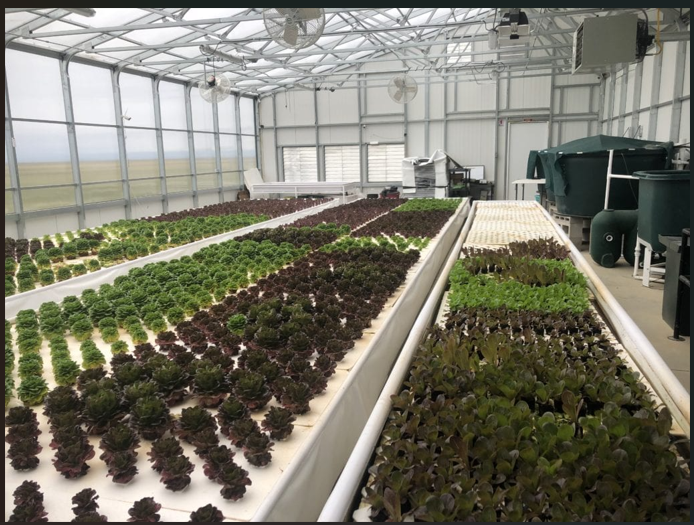
Aquaponics is TL&C Farmland's engine for year-round food production — and a living classroom where youth learn science, sustainability, and what it means to build something that sustains itself.
Aquaponics combines aquaculture (raising fish) with hydroponics (growing plants without soil) into one self-sustaining system. The fish produce waste. The waste feeds the plants. The plants clean the water. The clean water returns to the fish. No pesticides. No soil. No off-season.
Most farm programs go quiet in winter. Residents get bored, routine breaks down, and progress stalls. TL&C Farmland's greenhouse aquaponics operation runs year-round — which means the program runs year-round too.
Climate-controlled greenhouse environments maintain optimal growing conditions through every season — no cold gaps, no harvest lulls.
Leafy greens (lettuce, kale, spinach, basil), tomatoes, cucumbers, peppers, and herbs — all produced in staggered cycles to ensure consistent availability at farmers markets and local buyers.
Fish production adds a premium protein source — both for the residents' own nutrition and as a marketable product. Tilapia and catfish grow quickly and command strong market prices.
Consistent production means consistent revenue — from farmers market stalls, local restaurant partnerships, and CSA (community-supported agriculture) subscriptions that fund the program year-round.
A significant portion of what residents eat comes directly from the farm. Fresh vegetables, herbs, and fish reduce food costs and show residents exactly where their food comes from — something most have never experienced.
Aquaponics uses 90% less water than conventional farming. Combined with composting, solar considerations, and zero synthetic inputs, TL&C Farmland models regenerative agriculture from day one.
Youth at TL&C Farmland don't observe the aquaponics system — they run it. From their first week as a Seedling to their final months as a Root, every resident earns increasing responsibility over the system that feeds them.
New residents learn aquaponics basics: how the nitrogen cycle works, daily fish feeding routines, water quality monitoring, and basic plant care. They begin to understand that every action has a consequence — neglect the fish and the plants suffer.
Sprouts take ownership of a greenhouse section independently. They manage a full grow bed, track yields, and begin to understand the system as a business — what sells, what grows fastest, and how to optimize for both.
Harvest-level residents take the product to market. They pack orders, set up farmers market stalls, interact with customers, and handle money. They learn that growing food is one skill — selling it is another — and both matter.
Root-level residents have the full picture. They can run the aquaponics operation, train newer residents, and evaluate whether an agri-entrepreneurship path — their own operation someday — is the right next chapter.
Aquaponics isn't just for people who want to farm. The skills learned in TL&C Farmland's greenhouse translate into growing industries and real employment opportunities across multiple sectors.
Indoor farming and greenhouse operations are a booming industry. Graduates with hands-on aquaponics experience are positioned for roles at vertical farms, commercial greenhouses, and urban agriculture companies.
Aquaponics overlaps with biology, chemistry, and ecology. Residents who discover a passion for the science have a direct bridge to community college environmental programs, sustainability degrees, and education careers.
Root-level residents who've managed a profitable grow section have the foundation to start their own operation. TL&C Farmland provides business mentorship, connections to micro-loan programs, and alumni support for graduates who want to build their own.
Understanding where food comes from — and cooking with fresh, farm-grown produce daily — gives residents a foundation for culinary careers, restaurant work, and food systems roles that most applicants their age lack.
The aquaponics system doesn't just grow food. It teaches every resident the most important lesson we know: when you take care of something, it takes care of you back.
TL&C Farmland's mission is building self-sufficient adults. Aquaponics embodies that mission — a system that sustains itself, managed by people who learn to sustain themselves.
Fresh, local produce from TL&C Farmland reaches the surrounding community — reducing food deserts, building neighborhood relationships, and demonstrating what foster youth are capable of.
Revenue from aquaponics production directly supports the program's operational costs — creating a sustainable funding model that reduces dependence on grants and donations over time.
Donations, partnerships, and volunteer support help us expand the aquaponics operation and reach more young people with the skills they need to build a real future.
Get Involved →Stay in the loop.
Farm updates, volunteer days, and ways to help. No spam.
🔒 We’ll never share your info.